Showing posts with label aminoacids. Show all posts

Apr 14, 2011

Peptide bond says "Proteins from aminoacids"

  Proteins are the body building materials of most of the organisms.Proteins are otherwise known as polymers of aminoacids.Two aminoacid is bonded through a peptide bond to form a peptide.Further these peptides are connected to form polypeptides, which on combination forms proteins.
Peptide bond:
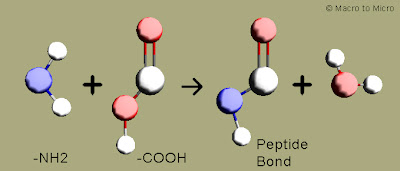
The -NH2 group of one aminoacid makes a bond with -COOH of another aminoacid by giving out a water molecule to form -CONH.This is known as peptide bond.


Apr 8, 2011

Aminoacid 2 - Arginine

Arginine is also an α-amino acid.
Properties:
Molecular Formula :- C6H14N4O2
Molar mass :- 174.2 g mol−1
Structures:
The amino acid side chain of arginine consists of a 3-carbon aliphatic straight chain, the distal end of which is capped by a complex guanidinium group.With a pKa of 12.48, the guanidinium group is positively charged in neutral, acidic and even most basic environments, and thus imparts basic chemical properties to arginine. Because of the conjugation between the double bond and the nitrogen lone pairs, the positive charge is delocalized, enabling the formation of multiple H-bonds.

3D structures:

Apr 7, 2011

Aminoacid 1 - Alanine

Alanine is an α-amino acid with the chemical formula CH3CH(NH2)COOH. Alpha α-carbon refers to the carbon directly bonded to the functional group.Here the carbon attached to the -COOH carboxylic group is called as Alpha carbon and hence it is named as alpha amino acid. It is classified as a nonpolar amino acid. D-Alanine occurs in bacterial cell walls and in some peptide antibiotics.
Properties:
Molecular Formula :- C3H7NO2 
Molar mass :- 89.09 g mol−1
Appearance :- White powder
Solubility :- Soluble in water
Melting point :- 258 ºC
Structure:
The α-carbon atom of alanine is bound with a methyl group (-CH3), making it one of the simplest α-amino acids with respect to molecular structure and also resulting in alanine's being classified as an aliphatic amino acid. The methyl group of alanine is non-reactive and is thus almost never directly involved in protein function.

Apr 6, 2011

Amino acids

 What are aminoacids?
Amino acids are molecules containing an amine group, a carboxylic acid group and a side-chain that varies between different amino acids. The key elements of an amino acid are carbon, hydrogen, oxygen, and nitrogen. They are particularly important in biochemistry, where the term usually refers to alpha-amino acids.
An alpha-amino acid has the generic formula H2NCHRCOOH, where R is an organic substituent; the amino group is attached to the carbon atom immediately adjacent to the carboxylate group (the α–carbon). Other types of amino acid exist when the amino group is attached to a different carbon atom; for example, in gamma-amino acids (such as gamma-amino-butyric acid) the carbon atom to which the amino group attaches is separated from the carboxylate group by two other carbon atoms. The various alpha-amino acids differ in which side-chain (R-group) is attached to their alpha carbon, and can vary in size from just one hydrogen atom in glycine to a large heterocyclic group in tryptophan.